Deportation, Inc.: The Rise of the Immigration Enforcement Economy
A multi-part video investigation into how U.S. immigration enforcement has expanded into a sprawling industry shaped by private profit and political influence.
Collaborators:
Lawfare, Jon Nealon, The Intercept
Location:
United States
Completion:
2024-Ongoing
Over the past three decades, the militarization of the United States’ southern border has advanced through a familiar political logic: the portrayal of migrants as a racial, linguistic, and political threat. Although the Trump administration amplified this sentiment, it predates him by decades. And while the physical presence of walls, checkpoints, and patrols remains the dominant visual shorthand, migrants are caught moving through far more complex systems of infrastructure, bureaucracy, and public-private power—machineries that operate with limited scrutiny.
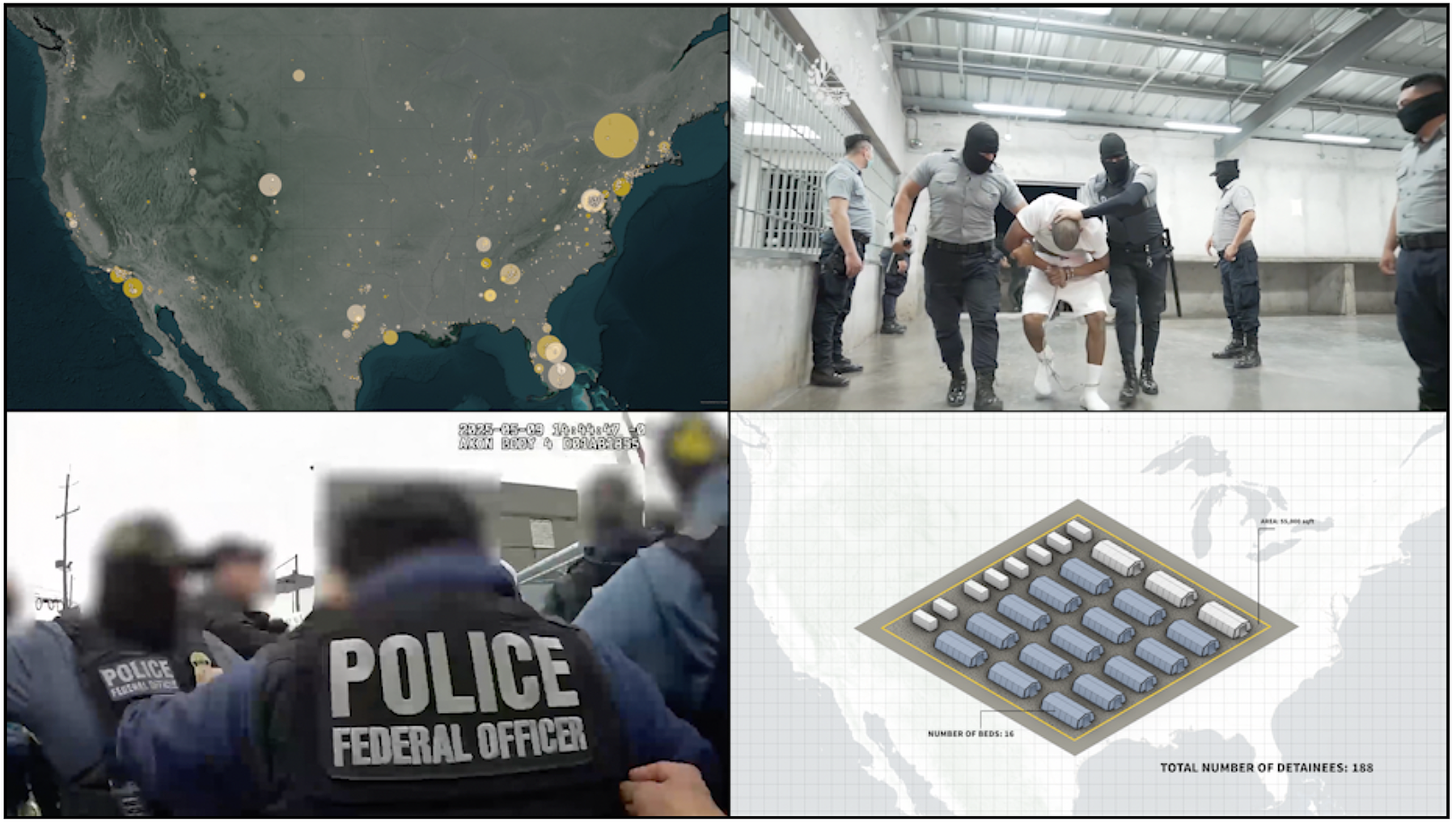
Deportation, Inc.: The Rise of the Immigration Enforcement Economy is a new series of short investigative videos that examines how U.S. immigration enforcement has evolved into a rapidly growing multi-billion-dollar industry shaped by private profit and political power—a system in which profitability increasingly dictates policy and enforcement priorities.
In December 2025, the first chapter of the series on Detention, was released alongside companion podcasts on Lawfare and The Intercept. In September 2026, the second chapter on Removal was released and published on The Intercept's "War on Immigrants," with a new article by Lawfare's Managing Editor, Tyler McBrien.
In public discourse, immigration is often represented through partisan rhetoric. But behind the noise lies a quieter, steadier transformation: the growth of a vast enforcement apparatus backed by extraordinary federal spending and sustained by an expanding constellation of private contractors. What began as a bureaucratic function within the Immigration and Naturalization Service has, since 9/11, been reframed as a national security mandate. Under the Department of Homeland Security, immigration enforcement budgets have climbed year after year, across administrations and political divides. Today they constitute the majority of federal law-enforcement spending. With the passage of HR1, that number is poised to rise even further—creating significant new opportunities for corporate profit.
The consequences of this are visible on multiple fronts. Private prison corporations now operate the overwhelming majority of long-term detention centers, governed by contracts that guarantee minimum bed payments regardless of occupancy and create incentives to maintain high populations. Temporary “soft-sided” facilities—large tent encampments erected on short notice—have become a parallel industry, offering rapid deployment at scale. States and municipalities have begun exploiting jurisdictional gaps to build their own detention facilities, sometimes without federal oversight. And in some cases, the machinery of enforcement now extends across borders entirely, in places like CECOT, with migrants held in foreign facilities and used as bargaining chips in international negotiations.

These dynamics collectively form what we call the “immigration enforcement economy”: a system in which the movement, detention, and vulnerability of migrants generate political value, operational capacity, and financial profit. Understanding how this economy operates—its actors, incentives, and consequences—is essential at a moment when mass deportation is once again being presented as a centerpiece of national policy.
Methodology
Our work on Deportation, Inc. brings together diverse forms of evidence—satellite imagery, procurement records, federal contracts, video documentation, geospatial datasets, and archival material—into a coherent analytic framework. While enforcement agencies often speak of “interoperability” as an internal technical goal, our practice repurposes the same dispersed information streams to build public understanding and transparency.

A key part of this investigation, we developed a custom parametric modeling tool to explore how detention facilities are planned and scaled. Using regulatory standards from OSHA, contractor specifications, and spatial data, the tool can estimate detention capacity across a wide range of scenarios—from small-scale tent camps to the large facilities proposed by federal and state governments. By procedurally modeling bed counts, spacing requirements, sanitation thresholds, and environmental constraints, the tool makes visible the human implications of proposals that are often announced in political terms rather than physical ones. When new facilities, contracts, or expansions are announced, the model allows us—and our journalistic partners—to evaluate whether these claims are materially plausible and what their material impacts would be.
Alongside this technical work, we developed geospatial mappings that trace the expanding reach of the enforcement network. By situating detention centers, soft-sided facilities, enforcement jurisdictions, and private-sector contracts within a unified spatial frame, we are able to reveal patterns that are otherwise hidden in text-based procurement documents: the concentration of profit in remote or economically vulnerable regions; and the ways state-level prohibitions are circumvented by federal transfers or extra-jurisdictional arrangements.

Deportation, Inc. examines the structures that have allowed the immigration enforcement economy to grow with limited oversight and deep political entrenchment. The project raises questions about what it means when the detention and movement of migrants become sites of financial growth for publicly traded corporations, when enforcement strategies are shaped not only by policy but by profit incentives, and when the border itself transforms from a line on a map into a diffuse network of technologies, contracts, and political bargains.
This investigation forms the foundation of an ongoing video series that traces the three major pillars of the enforcement economy: surveillance, detention, and removal. Through this work, we aim to support a more informed public debate—one grounded in evidence, historical context, and the lived realities of those most affected.
Upcoming episodes on surveillance and data collection, along with additional live public events will follow this fall/winter 2026.
Deportation Inc.: Investigating the Business of Migrant Detention, was the first public event and occurred on May 7, 2026 at e-flux Screening Room, in partnership with Lawfare and The Architectural League of New York. The conversation featured an introduction by Brad Samuels, followed by a conversation with Gauri Bahuguna, Eileen Grench, Elora Mukherjee, Jon Nealon, and was moderated by Tyler McBrien. The video recording can be accessed below.
The second public event took place on September 24, 2026 at The Festival Center in D.C., organized by SITU and Lawfare. We pre-screened the second chapter, Deportation Inc.: Investigating the Business of Migrant Removal, and hosted a conversation with Nick Turse, investigative reporter at The Intercept, Aaron Reichlin-Melnick, Senior Fellow at the American Immigration Council, and Setareh Ghandehari, Advocacy Director at Detention Watch Network. The program was moderated by Lawfare's Tyler McBrien and introduced by Lawfare’s Executive Editor Natalie Orpett.