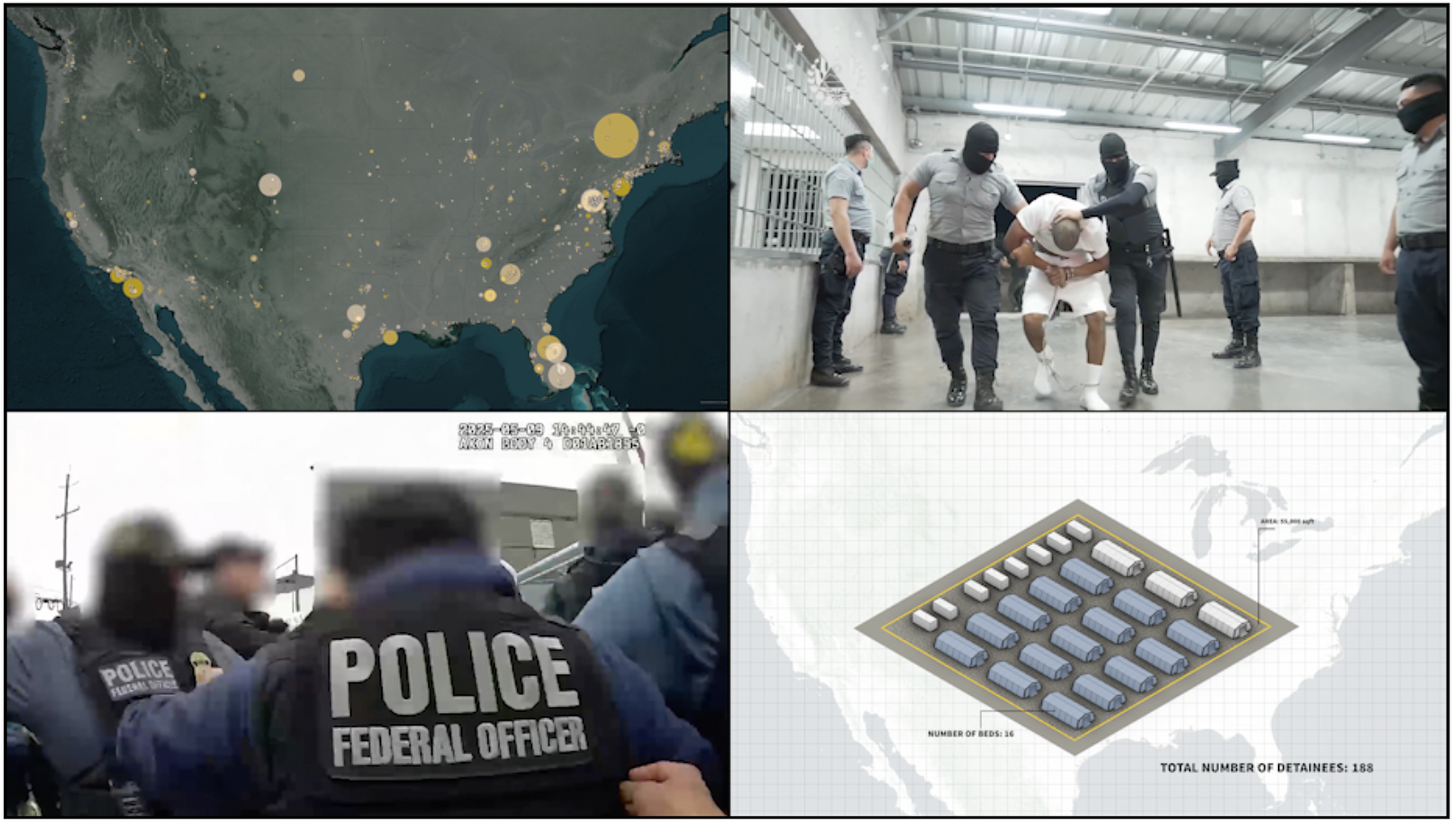
SITU and Lawfare Release First Installments of “Deportation, Inc.: The Rise of the Immigration Enforcement Economy” — A New Investigative Video Series on the U.S. Immigration-Industrial Complex
December 3rd 2025FOR IMMEDIATE RELEASE — New York City, [December 10, 2025]: Lawfare and SITU Research announce the release of Deportation, Inc.: The Rise of the Immigration Enforcement Economy — a new series of short investigative videos examining how U.S. immigration enforcement has evolved into a rapidly growing multi-billion-dollar industry shaped by private profit and political power — a system in which profitability increasingly dictates policy and enforcement priorities.
This first installment launches two videos — an introduction that situates the project’s historical and political context, and a second short documentary focused specifically on detention — will be available beginning December 10 on Lawfare's YouTube channel. This release will be followed by a Lawfare podcast episode featuring interviews with journalists, policy experts, and advocates. Future episodes on deportation and surveillance, along with additional companion podcast interviews and a live public event will follow in early 2026.
The framing of the series draws on the cautionary tale of Dwight D. Eisenhower's farewell address, in which he coins the term “military industrial complex” and warns “against the acquisition of unwarranted influence, whether sought or unsought.” Deportation, Inc. asks whether the United States is now seeing the emergence of a new industrial complex — one driven by immigration enforcement.
The series opens with the political resurgence of Donald Trump and his campaign promise to carry out the largest deportation operation in U.S. history. Behind that rhetoric lies a decades-long transformation: the steady privatization of immigration enforcement that accelerated with the post-9/11 creation of the Department of Homeland Security. Since then, immigration control has continued to expand dramatically, now accounting for nearly two-thirds of all federal law-enforcement spending. With the passage of H.R. 1 — the so-called “Big Beautiful Bill” — that figure is projected to climb even higher, embedding border enforcement within a vast ecosystem of private contractors, defense firms, and data companies. The second video, focused specifically on the detention sector and the private facilities in which nearly 90 percent of detained immigrants are held, shows how corporations such as GEO Group and CoreCivic profit from federally guaranteed contracts that incentivize keeping detention centers at full capacity.
Director at SITU Research, Brad Samuels, said, “An analog to the rise of the Military Industrial Complex identified by Eisenhower in his farewell address, the immigration enforcement economy is beginning to cut a similar profile. This project looks at what happens when the business of interdiction, tracking, detention and deportation becomes too large to fail.”
This marks the first collaboration between Lawfare and SITU, bringing together Lawfare’s legal analysis and national security focus with SITU’s geospatial analysis, mapping of procurement data, and a new parametric modeling tool that visualizes detention scenarios at different scales. Together, the videos render visible how public money and private expansion intersect, often beyond the reach of oversight or public accountability. The detention episode, in particular, examines how this dynamic plays out across permanent prisons, “soft-sided” tent camps, and offshore sites, showing how public funding fuels private growth while obscuring the human costs of detention. At this scale, profitability itself becomes a policy engine: economic incentives begin to shape enforcement priorities, expand detention capacity, and normalize practices once considered extraordinary.
Managing Editor for Lawfare, Tyler McBrien, said, “The line between legitimate business and graft is a blurry one in a system that outsources immigration enforcement and other integral parts of public administration to the private sector. When government officials are nothing more than clients looking for vendors, where does democracy end and kleptocracy begin?"
Through this project, Lawfare and SITU bring legal and policy analysis and visual investigations into a single documentary register, demonstrating how economic incentives shape the nation’s approach to immigration enforcement.
Video links:
To access the introductory and detention videos, see here.
Credits:
Producer/Editor: Jon Nealon; Lawfare: Tyler McBrien; SITU Research: Gauri Bahuguna, Ali Hafez, Brad Samuels, Evan Grothjan; Narrator: Laura Genes; Music: Jon Nealon
About SITU Research
SITU Research is a visual investigations practice developing new forms of reporting to cut through digital noise and amplify truth. As an interdisciplinary team of architects, computer scientists, and researchers, we take a rigorous and comprehensive approach to synthesizing disparate forms of evidence in order to provide complete accounts of contested events. Whether in the form of interactive digital platforms or 3D site reconstructions, our visual tools allow victims and their advocates to access contextualized and reliable reports of what really happened. Our collaborators and clients have included: The International Criminal Court, The United Nations, Pacific Island Students Fighting Climate Change, The Intercept, PBS Frontline, Don’t Shoot Portland, National Lawyers Guild, The Associated Press and Human Rights Watch, among others.
About Lawfare
Lawfare is a non-profit multimedia publication dedicated to “Hard National Security Choices.” We provide non-partisan, timely analysis of thorny legal and policy issues through our written, audio, and other content. We aim to improve the discourse on the law and policy of national security with a relentless focus on substantive issues that matter—in a fashion that is useful to policymakers and practitioners, but also accessible to anyone who wants to access it. Our areas of coverage range from national security law, threats to democracy, cybersecurity, executive powers, content moderation, domestic extremism, and foreign policy, among many others.
Contact
For questions regarding booking inquiries, contact Lawfare: press@lawfaremedia.org
For high-resolution stills, excerpts, and media assets, contact SITU Research: press@situ.nyc